

Is a Portable Projector Worth It for Small Apartments?
Table of Contents
- The Real Trade-Off: Space Savings vs. Setup Complexity
- Portable Projector vs. Smart TV for Apartments: Which Fits Your Space
- Understanding Portable Projector Brightness Requirements
- How to Set Up a Projector in a Small Apartment
- Key Factors That Actually Matter for Small Spaces
- The Hidden Costs: Maintenance and Long-Term Durability
- When a Portable Projector Actually Makes Sense
- Frequently Asked Questions
Last Updated: September 3, 2026
The Real Trade-Off: Space Savings vs. Setup Complexity
A portable projector worth it for small apartments depends entirely on what you're willing to sacrifice. You gain flexibility and compact storage. You lose simplicity and, often, image quality compared to a traditional smart TV.
The appeal is obvious: a projector that fits in a backpack sounds perfect for cramped living spaces. No massive screen taking up wall real estate. No permanent installation required. For renters especially, this matters. But here's what most guides miss: portable projectors demand more from you than a TV ever will. You're managing throw distance, wall color, ambient light, cable routing, and audio separately. Each variable compounds the others.
The question isn't whether portable projectors are good technology. They are. The question is whether the trade-offs align with how you actually live. Most people discover too late that their apartment wasn't designed for projection, and no amount of portability fixes that.
At Uniq Trenz, we understand that small-space living requires solutions that genuinely fit your reality, not just theoretically. That's why we've analyzed what actually works for apartment dwellers versus what sounds good in product marketing. Below, we'll walk through the real considerations that determine whether is a portable projector worth it for small apartments in your specific situation.
Portable Projector vs. Smart TV for Apartments: Which Fits Your Space
For most apartment dwellers, a smart TV remains the more practical choice. It works immediately. No setup required. No ambient light management. No throw distance calculations. A 55-inch TV costs less than a quality portable projector and delivers consistent performance without variables.
But a projector wins in specific scenarios. If you have one blank wall and you're willing to optimize your room around projection, a portable projector creates an immersive experience a TV simply cannot match. The screen size advantage is real: you can project 100 inches on a wall where a TV would never fit physically or aesthetically.
The catch: your apartment needs to cooperate. Light-colored walls work. Dark walls kill image brightness. Windows require blackout solutions. Furniture placement must accommodate throw distance. These aren't minor inconveniences. They're structural constraints that determine whether the projector actually works in your space.
A TV adapts to your room. A projector requires your room to adapt to it.
If you rent, consider this carefully. Projectors need mounting solutions or stable tripod placement. TVs mount to any wall with basic hardware. If your lease restricts wall modifications, a TV is already the winner. If you move frequently, packing and recalibrating a projector setup becomes tedious quickly. A TV travels in a box.
For apartment living specifically, the portability advantage of a projector shrinks considerably once you account for the full ecosystem: screen, mount, cables, audio setup. You're not actually carrying a complete system anywhere easily. You're carrying a projector and leaving the rest behind.
Understanding Portable Projector Brightness Requirements
Brightness measured in lumens determines whether your projector actually displays an image you can see. This is the single most misunderstood specification in portable projector marketing.
Here's the reality: most portable projectors advertise 300-500 lumens. In a dark room, this works. In any other condition, it struggles. Apartment living rarely means dark rooms. You have windows. You have ambient light from phones, lamps, and hallway doors. That light directly competes with your projector.
A quality portable projector for small apartments needs at least 800-1000 lumens minimum if you want to watch during daytime or with normal indoor lighting (cnet.com). Anything less requires blackout conditions. If you're blackout-dependent, you've essentially purchased a device that only works in specific circumstances. That's not flexibility. That's a limitation disguised as portability.
The brightness-to-size relationship matters too. Projecting a 100-inch image requires significantly more lumens than projecting 60 inches. Portable projectors excel at smaller throws (closer to the wall), which means smaller images. A 60-80 inch image from a portable projector in an apartment is realistic. A 100-inch image requires either more lumens than most portable models offer or a darker room than most apartments provide.
Wall color directly impacts brightness perception. A white wall reflects projected light effectively. A light gray wall loses brightness noticeably. Anything darker than that requires additional lumens to compensate. If your apartment has colored walls, you're either repainting or accepting dimmer images. Neither option is convenient.
How to Set Up a Projector in a Small Apartment
Setting up a portable projector in a small apartment means solving three interconnected problems simultaneously: throw distance, cable management, and acoustic performance.
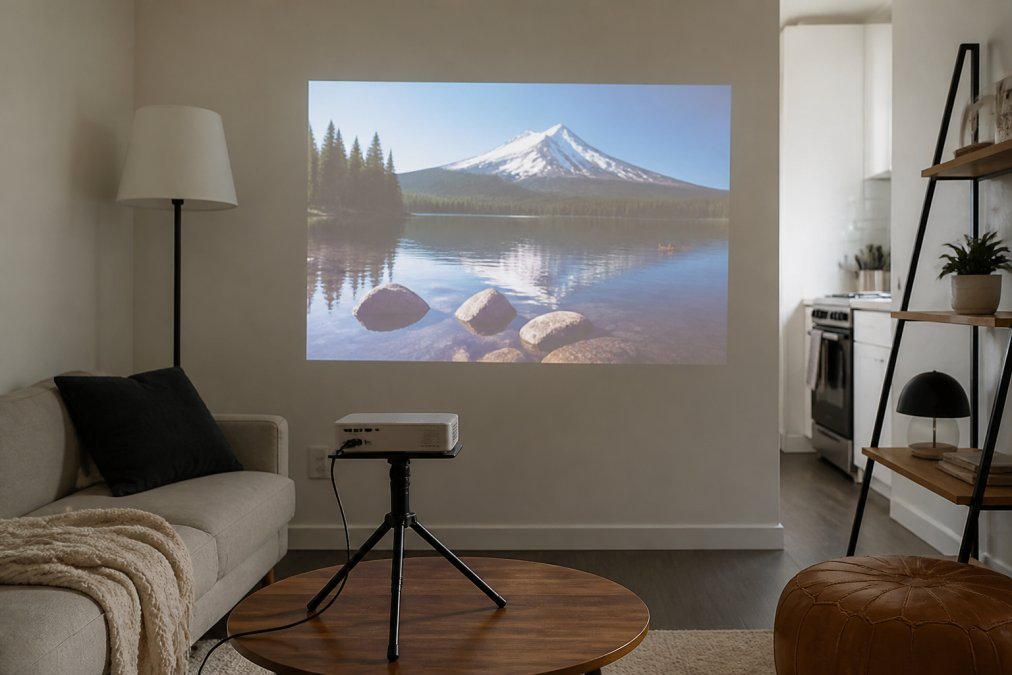
Throw Distance and Screen Size Considerations
Throw distance is the distance from the projector to the wall. This determines your screen size. You cannot ignore this specification, yet most apartment dwellers discover it only after purchasing.
A short-throw projector sits 3-6 feet from the wall and displays 60-80 inches. A standard-throw projector sits 8-12 feet from the wall for the same size. Your apartment's layout determines which type works. If you have a living room 12 feet deep, standard-throw works. If your space is 8 feet deep, you need short-throw or you're projecting a tiny image.
Measure your actual wall space before buying anything. Account for furniture, doorways, and traffic patterns. A projector mounted on a tripod in the middle of your apartment is impractical. You'll move it constantly or trip over it. Wall mounting is better, but requires drilling holes, a problem if you rent.
The projector's keystone correction feature helps with angled mounting, but overusing it degrades image quality. Aim for perpendicular projection when possible. This means positioning the projector at the center height of your wall, pointed directly at it. In small apartments, this is often impossible. You'll accept some keystone adjustment as a trade-off.
Cable Management and Mounting Solutions
This is where portable projectors reveal their hidden complexity. You need:
- A power cable (usually 6-10 feet minimum)
- An HDMI cable from your media source
- Potentially an audio cable to external speakers
- A mounting solution (tripod, wall bracket, or ceiling mount)
In a small apartment, these cables become visible clutter. Running cables along walls, under furniture, or across doorways looks unprofessional and creates tripping hazards. Wireless casting helps, but introduces latency and reliability issues that wired connections avoid.
Wall mounting requires drilling. Ceiling mounting requires more drilling and potentially structural concerns. A tripod avoids permanent installation but occupies floor space and looks temporary. None of these options are seamless in apartment living.
Cable management solutions exist: raceways, clips, and conduit hide wiring effectively. They cost extra and require installation time. If you're renting, you're limited to non-permanent options that look makeshift.
The practical approach: accept visible cables or invest in wireless casting and accept occasional connectivity issues. Neither option is ideal. Both are compromises that a TV avoids entirely.
Key Factors That Actually Matter for Small Spaces
Three variables determine whether a portable projector actually works in your apartment: ambient light management, audio performance, and connectivity reliability. These matter more than lumens or resolution because they directly impact your daily experience.
Ambient Light and Wall Color Impact
Ambient light is your projector's enemy. Every light source in your room, ceiling fixtures, lamps, windows, even your phone screen, reduces image brightness and contrast. In small apartments, controlling ambient light is difficult.
Blackout curtains help but require installation and look institutional. Window films reduce light without full blackout. Dimmer switches on ceiling lights provide flexibility. None of these solutions are free or invisible.
Wall color determines how much light your projector reflects back to you. White walls are ideal. Light gray works acceptably. Anything darker than that requires additional lumens. Many apartments have off-white or beige walls. These are compromise colors that reduce perceived brightness compared to pure white.
If your apartment has textured walls, projection quality suffers. Texture scatters light, reducing sharpness and contrast. Smooth walls are significantly better. If you rent, repainting walls to optimize projection is unrealistic.
The real consideration: how much time and money are you willing to invest in optimizing your room's light and color specifically for projection? If the answer is "not much," a TV remains more practical.
Audio Performance and Fan Noise in Close Quarters
Portable projectors generate fan noise. Most models run 25-35 decibels, roughly equivalent to a quiet refrigerator. In a small apartment where you're sitting 8-10 feet from the projector, that noise is noticeable during quiet scenes.
Some portable projectors are quieter (20-25 decibels). These cost more and often sacrifice brightness or cooling efficiency. Others are louder (35-45 decibels), making them unsuitable for apartments where neighbors share walls.
Built-in speakers on portable projectors are almost universally poor. You'll want external speakers. This means additional cables, additional equipment, and additional cost. A soundbar or compact speaker system adds $100-300 to your setup. A TV with decent built-in audio doesn't require this investment.
Acoustic treatment in small apartments is also worth considering. Hard surfaces (tile, hardwood) amplify projector noise and create echo. Soft furnishings (curtains, rugs, upholstered furniture) absorb sound. If you're optimizing for projection, you're also managing acoustics. This compounds the complexity.
Connectivity, Wireless Casting, and Streaming Apps
Portable projectors vary dramatically in connectivity. Some support wireless casting via Miracast or AirPlay. Others require HDMI cables exclusively. Some include built-in streaming apps (Netflix, Hulu, YouTube). Others don't.
For apartment living, wireless casting sounds ideal. In practice, it's unreliable. Latency occurs. Connection drops happen. Streaming quality varies based on WiFi signal strength. If your apartment has WiFi dead zones, wireless projectors perform poorly in those areas.
HDMI cables are reliable but visible. Running cables across your apartment to reach a projector looks messy. Wireless casting is convenient but temperamental. You're choosing between aesthetics and reliability.
Built-in streaming apps are convenient but limited. Most projectors offer basic apps only. If you use niche streaming services, you'll need to connect a separate device (Roku, Apple TV, Fire Stick) via HDMI. This adds another cable and another piece of equipment.
A TV with built-in apps and reliable HDMI ports handles all of this more seamlessly. This isn't a minor advantage in apartment living where simplicity and aesthetics matter.
The Hidden Costs: Maintenance and Long-Term Durability
Portable projectors require maintenance that TVs don't. The cooling fan collects dust. The lens needs occasional cleaning. The light source degrades over time (especially with lamp-based models). Replacement lamps cost $100-300 and last 2,000-5,000 hours (rtings.com).
In a small apartment with limited ventilation, dust accumulation is faster. Your projector may need cleaning more frequently than in larger, better-ventilated spaces. This is an ongoing cost in time and potentially money.
Long-term durability varies. Quality portable projectors last 5-7 years with regular maintenance (cnet.com). Cheaper models fail sooner. A TV typically lasts 7-10 years with minimal maintenance. The durability advantage favors TVs.
If you move frequently, transporting a projector repeatedly stresses components. Lenses can shift. Mirrors can misalign. Repeated packing and unpacking accelerates wear. A TV, while heavier, is more strong to repeated moves.
The total cost of ownership for a portable projector includes the device, screen or wall optimization, mounting hardware, audio equipment, cables, and eventual replacement. This often exceeds the cost of a quality TV when amortized over 5-7 years.
When a Portable Projector Actually Makes Sense
A portable projector is worth it for small apartments in these specific scenarios:
You prioritize screen size over simplicity and you have a dedicated blank wall. You're willing to optimize your room's lighting and color specifically for projection. You watch primarily in darker conditions (evening or night). You value the immersive experience enough to manage the complexity. You don't move frequently. You can afford the full ecosystem (projector, screen/wall optimization, audio, mounting).
You also have a backup plan. If the projector underperforms in your space, you can return it or repurpose it. Portable projectors are portable, you can test them in different rooms before committing to permanent placement.
For most apartment dwellers, these conditions don't align. A TV is simpler, more reliable, and ultimately more practical. The portability advantage of a projector shrinks when you account for the full setup ecosystem. You're not carrying a complete system anywhere easily.
If you do choose a projector, prioritize brightness (800+ lumens minimum), short-throw capability for small spaces, and quiet operation. Expect to spend $400-800 on a quality portable projector plus $100-300 on audio equipment. Accept that your apartment will require some optimization. Plan for ongoing maintenance.
For small-space living specifically, Uniq Trenz offers the Northern Lights Star Projector at $89.99, an excellent entry point if you want to test projection without major investment. It's designed for atmospheric ambiance rather than primary entertainment, which aligns well with apartment constraints. It creates the immersive experience projectors promise without demanding the full ecosystem optimization that larger models require.
The decision between a portable projector and a TV for apartment living isn't about which technology is superior. It's about which aligns with your space, your patience for optimization, and your tolerance for complexity. A TV works immediately. A projector requires you to work. In small apartments where space is already constrained, that difference matters significantly. If you're willing to invest the time and accept the trade-offs, a portable projector delivers an experience a TV cannot match. If you value simplicity and reliability, a TV remains the practical choice. Evaluate your apartment's specific constraints, wall space, ambient light, ventilation, cable routing, before deciding. The right choice depends entirely on your actual living conditions, not on the technology's theoretical advantages.
Frequently Asked Questions
Are portable projectors worth buying for a small apartment?
A portable projector can be worth it if you prioritize flexibility and don't have wall space for a TV. They excel in apartments where you want to project onto different surfaces or move the setup between rooms. However, they require careful planning around throw distance, ambient light control, and brightness (lumens). The trade-off is that setup takes longer than turning on a TV, and image quality depends heavily on your wall color and room lighting conditions.
What brightness level do I need for a portable projector in a small apartment?
For small apartments with controlled lighting, aim for at least 500-800 lumens if you have some ambient light, and 1000+ lumens if your windows face bright sunlight. Smaller rooms mean less throw distance, so the projected image stays relatively bright even with moderate lumen output. Test brightness in your actual room before buying, specs don't always match real-world performance, especially with wall color and paint finish variations.
How do I set up a projector in a small apartment without damaging walls?
Use a portable tripod or ceiling-mounted bracket instead of drilling holes. Position the projector perpendicular to your projection surface to minimize keystone correction (which degrades image quality). For cable management, run cables along baseboards using adhesive clips or conduit. Many small-apartment dwellers use removable projector screens or project onto a light-colored wall. Battery-powered or wireless projectors eliminate cable clutter and offer maximum setup flexibility.
Should I choose a portable projector or smart TV for a small apartment?
A smart TV is simpler and faster to use, but a portable projector creates a larger viewing experience in less physical space. TVs need wall or furniture placement; projectors need a projection surface and throw distance. Projectors excel for movie nights and entertainment; TVs are better for frequent, casual viewing. Consider your viewing habits: if you watch daily, a TV's convenience wins. If you want flexibility and occasional immersive experiences, a portable projector offers versatility that a fixed TV cannot.
This article was written using GrandRanker