

Table of Contents
- Why Wall Storage Beats Cabinet Clutter in Small Kitchens
- Renter-Friendly Wall Storage That Won't Cost Your Deposit
- Small Kitchen Organization Hacks That Use Every Inch
- Space-Saving Kitchen Gadgets Worth Mounting
- Weight Limits and Installation: What Your Walls Can Handle
- Making Wall Storage Look Good in a Small Space
- Conclusion
- Frequently Asked Questions
Last Updated: September 20, 2026
Why Wall Storage Beats Cabinet Clutter in Small Kitchens
Clever kitchen wall storage solutions for apartments turn unused vertical space into working storage, freeing countertops and cabinets without adding a single square foot of floor area. At Uniq Trenz, we hear the same complaint constantly: the kitchen is fine, there's just nowhere to put anything. Wall storage fixes that by moving items off surfaces and onto the wall itself.
The logic is simple. Cabinets hold what they hold, and countertops fill up fast. Walls, meanwhile, sit empty. A U.S. Department of Housing and Urban Development guide to home safety notes that clear, uncluttered surfaces reduce trip and fall hazards in the home, which matters even more in tight kitchens where every inch is contested.
Below, we'll show you exactly how to mount storage that survives apartment life, holds real weight, and still looks intentional.
Renter-Friendly Wall Storage That Won't Cost Your Deposit
Renter-friendly wall storage is any system that adds function without permanent damage to walls, doors, or cabinets. That means adhesive mounts, tension rods, over-door hooks, and freestanding racks that lean rather than bolt. The goal is simple: full storage capability with a move-out that leaves no trace.
Most apartment leases prohibit drilling without written permission, and even where drilling is allowed, patching and repainting before a walkthrough is a hassle nobody wants. The practical workaround is to match the mounting method to the surface and the weight.
Match the Mount to the Surface
Not every wall takes every mount. A few rules of thumb:
- Painted drywall: adhesive strips work if the paint is cured (older than about a week) and clean. Fresh paint and textured finishes release faster.
- Glossy tile and glass: suction cups and removable adhesive both hold well here, provided the surface is degreased. This is the best surface in a kitchen for non-damaging mounts.
- Wallpaper and peel-and-stick coverings: avoid adhesive entirely. The strip can lift the paper when removed. Use over-door or freestanding options instead.
- Cabinet sides and interiors: tension rods and over-cabinet-door hooks need no adhesive at all.
Adhesive Hooks and Tension Rods: What They Actually Hold
Adhesive hooks work well for lightweight tools: measuring spoons, oven mitts, small towels, and lightweight utensils. They fail when you overload them or stick them to dusty or greasy paint. The failure mode is almost always the bond, not the hook.
Tension rods shine inside cabinets and between walls. A rod placed under the sink holds spray bottles upright. One inside a cabinet corrals cutting boards. Neither method requires a single screw.
Removal Without Damage
The part most guides skip: getting it all off cleanly at move-out.
- Adhesive strips: warm the strip with a hair dryer on low for 30 to 60 seconds, then pull the tab slowly and parallel to the wall, not straight out. Rushing the pull is what tears paint.
- Suction cups: twist to break the seal rather than prying at the edge.
- Tension rods: release the spring tension before removing, or you'll scrape the cabinet interior.
- Over-door hooks: lift straight up; never drag across the top of the door, which scuffs the finish.
A Note on Over-Door and Freestanding Options
Over-door organizers use the top edge of a cabinet or closet door as the anchor, no adhesive, no hardware. They're ideal for cleaning supplies, wraps, and foil. Freestanding racks that lean against a wall carry more weight than any adhesive system and relocate instantly, which makes them the safest bet for renters who move often.
Test any new adhesive mount with a light load for 24 hours before trusting it with anything breakable. If it holds overnight, it will usually hold long-term.
Small Kitchen Organization Hacks That Use Every Inch
Small kitchen organization hacks work best when they follow your cooking workflow rather than fight it. Put what you use daily at eye level, weekly items higher, and occasional items on top of cabinets.
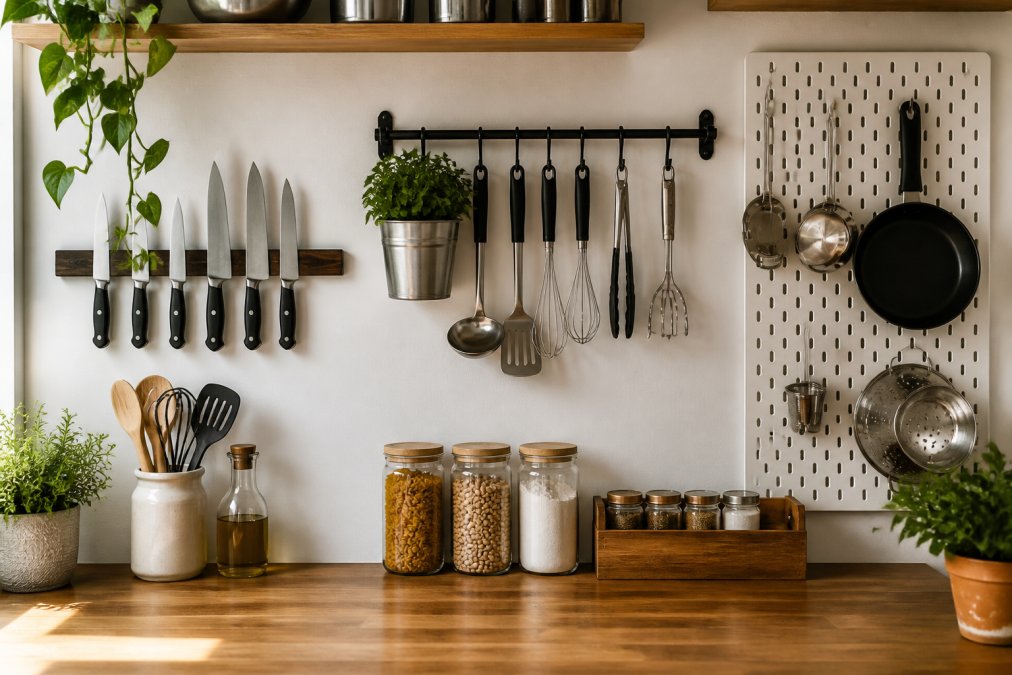
Hanging Rails, Magnetic Strips, and Pegboard Systems
Hanging rails hold utensils, small pans, and towels on S-hooks. Magnetic strips keep knives visible and off the counter. Pegboard systems offer the most flexibility because you rearrange hooks as your needs change.
| System | Best For | Mounting | Weight Range |
|---|---|---|---|
| Hanging rail | Utensils, towels, small pans | Screw or adhesive | Light to medium |
| Magnetic strip | Knives, metal tools | Adhesive or screw | Light |
| Pegboard | Mixed tools, cookware | Screw into studs | Medium to heavy |
| Tension rod | Cabinet interiors | Compression | Light |
Space-Saving Kitchen Gadgets Worth Mounting
Space-saving kitchen gadgets earn wall space only if you use them weekly. Anything used twice a year belongs in a box, not on display.
Wall-Mounted Kitchen Multi-Grain Sealed →
Mount your most-used gadget at the height where your hand naturally falls when standing at the counter. That's usually 45 to 55 centimeters above the surface. Anything higher becomes a reach you'll stop making.
Weight Limits and Installation: What Your Walls Can Handle
Weight capacity is the single most overlooked factor in kitchen wall storage, and it's where most setups fail. Adhesive hooks typically hold a few pounds at most. Screws into drywall anchors hold considerably more. Screws into studs hold the most. The gap between those categories is where injuries and broken dishes happen.
Rough Load Ranges by Mount Type
These are general ranges, not guarantees, always check the rating printed on the package:
- Adhesive strips and hooks: roughly 1 to 5 pounds per hook, depending on size and surface. Fine for utensils, towels, and light tools.
- Suction cups: 1 to 3 pounds on smooth, non-porous surfaces. They lose grip over time and should never hold anything breakable.
- Tension rods: 5 to 15 pounds when properly sized and seated between two solid surfaces. Good for spray bottles and cutting boards, not cast iron.
- Drywall anchors: 15 to 50 pounds per anchor, spread across multiple points. Suitable for shelving and small pot racks.
- Screws into studs: 50 pounds and up per point. The only reliable option for heavy cookware, cast iron, and full pot racks.
Why Overhead Storage Fails
A wall mount rarely fails all at once. It creeps: the anchor loosens, the adhesive stretches, the rod slips. That's why overhead storage is the riskiest placement. Anything mounted above head height should be rated for at least double the weight you plan to put on it, and heavy items should never go directly over a workspace or walkway.
Matching the Load to the Item
A quick decision path:
- Cast iron, stockpots, full pot racks: studs only, or skip the wall and use a freestanding rack.
- Everyday pans and skillets: drywall anchors across at least two points.
- Knives and metal tools: magnetic strips are fine on adhesive if the strip is short and the wall is smooth.
- Utensils, towels, oven mitts: adhesive or tension is plenty.
A Consumer Product Safety Commission guidance on anchoring and mounting is worth reading before you mount anything heavy overhead. Falling cookware is a real injury risk, not a hypothetical one.
Making Wall Storage Look Good in a Small Space
Aesthetic integration matters more in small kitchens because everything is visible at once. A wall of mismatched hooks reads as clutter, even when it's organized.
Renters who want storage that looks deliberate rather than improvised, and who plan to move within a year or two.
Conclusion
The hardest part of kitchen wall storage isn't finding hooks. It's choosing systems that hold real weight, respect your lease, and still look like they belong.
Frequently Asked Questions
How can I add kitchen wall storage without damaging my apartment walls?
Renter-friendly wall storage relies on adhesive hooks, tension rods, and over-the-cabinet systems instead of screws. Command-style adhesive hooks hold 2-5 pounds each, which is enough for utensils, small pans, and lightweight organizers. Tension rods fit inside cabinets or between walls to create instant hanging space. For heavier items, look for damage-free mounting strips rated for 10 pounds or more. Always clean the wall with rubbing alcohol first, let it dry completely, and press the adhesive firmly for 30 seconds. When you move out, pull the tab slowly and the strip releases without leaving holes.
What are the best space-saving kitchen gadgets for a tiny apartment?
The most effective space-saving kitchen gadgets mount on walls or stack vertically. A wall-mounted jar set keeps dry goods like rice and pasta off the counter. Collapsible colanders and measuring cups flatten for storage. Magnetic knife strips free up drawer space. A shelf kitchen organizer with adjustable tiers fits inside cabinets or on the counter to corral spices and utensils. Look for multi-functional items that replace two or three single-use tools. Compact designs that mount or fold away make the biggest difference in kitchens under 100 square feet.
How much weight can wall-mounted storage hold in an apartment?
Weight capacity depends on the mounting method. Adhesive hooks typically hold 2-5 pounds. Damage-free adhesive strips can handle up to 16 pounds for large strips. Tension rods hold 10-20 pounds depending on the spring strength and surface grip. Screw-mounted brackets into studs can support 50 pounds or more. For apartment walls, stay under 10 pounds per adhesive mount and distribute weight across multiple hooks. Never hang cast iron or heavy cookware on adhesive alone. Check your lease for any restrictions on wall mounting before you install anything.
What are some clever kitchen storage ideas for renters with limited cabinet space?
When cabinet space runs out, go vertical. Install a hanging rail above the backsplash for utensils and mugs. Use the inside of cabinet doors with over-the-door racks for lids and cutting boards. Stack a shelf organizer inside cabinets to double the usable height. Mount sealed jars on the wall for dry goods. A pegboard panel adds customizable storage for pots, pans, and tools. Tension rods under the sink hold spray bottles. These solutions use wasted vertical space and keep countertops clear without requiring permanent modifications.