

Table of Contents
- Why Standard Closet Organizers Fail in Tiny Homes
- Essential Measurements and Fit Checks Before You Buy
- Small Closet Organizer Types That Actually Save Space
- Hanging Closet Organizer Options for Renters and Tight Layouts
- Tiny Home Storage Ideas for Awkward and Unused Spaces
- Closet Organization Ideas for Small Spaces That Hold Up Over Time
- Weight Capacity, Installation Safety, and Durability Checks
- Conclusion
- Frequently Asked Questions
Last Updated: October 6, 2026
Why Standard Closet Organizers Fail in Tiny Homes
Most closet organizers are built for the wrong house.
This guide from Uniq Trenz covers the measurements, product types, and durability checks that separate an organizer that survives a move from one that sags by spring.
The core problem is fit, not storage volume. A shelf 2 inches too deep blocks a folding door; a rod at the wrong height leaves shirts dragging.
There is a second problem most guides skip: moisture.
Essential Measurements and Fit Checks Before You Buy
Measure first, buy second. Nearly every organizer return traces back to a skipped measurement, and a tiny home has no spare clearance to absorb a bad guess.
Work through these numbers with a tape measure before opening any product page:
- Interior width at the narrowest point, not the widest
- Interior depth from back wall to the door frame
- Usable height from floor to the lowest obstruction
- Door swing clearance in the open position
- Rod height and whether it is fixed or adjustable
Write each number down, a half-inch difference between the top and bottom of a wall is common in prefab and converted structures.
Door Swing, Rod Height, and Shelf Depth
Door swing is the measurement people forget, and it is the one that ruins the purchase.
Rod height matters just as much. A standard rod sits around 66 to 68 inches from the floor, but a tiny home may cap usable height lower because of a sloped ceiling or overhead cabinet.
Shelf depth is the last trap. Deep shelves hold more but eat floor space and block light.
Small Closet Organizer Types That Actually Save Space
The right organizer type depends on what is being stored, not on how the closet looks in a photo.
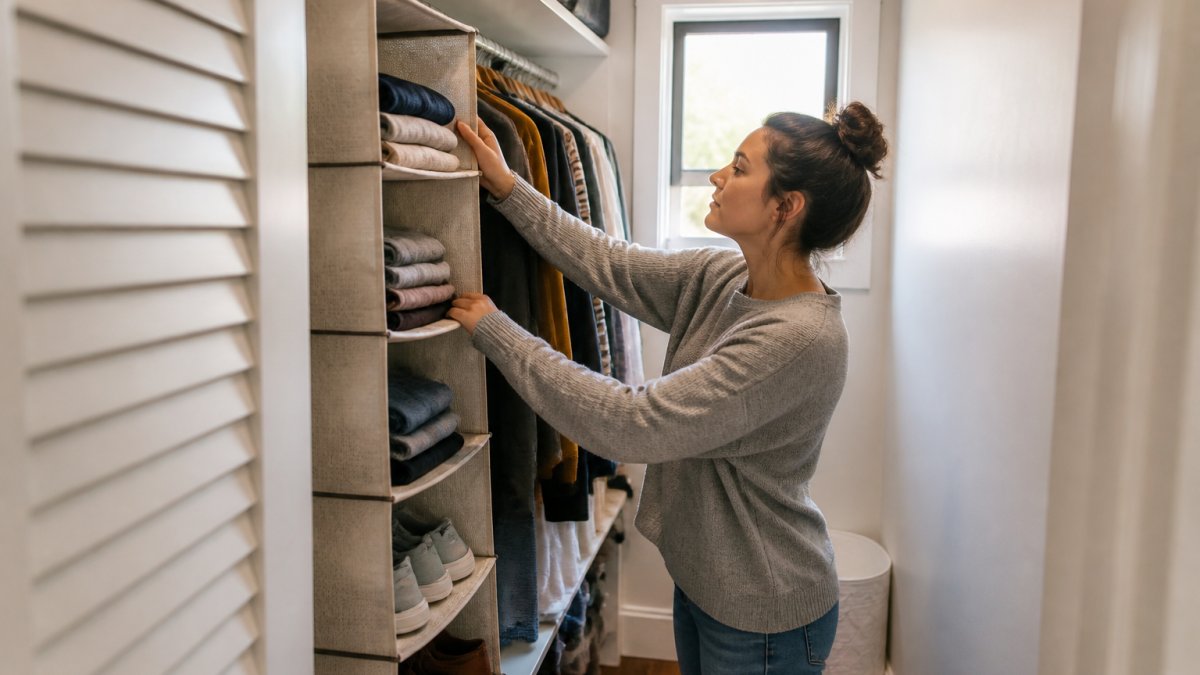
Hanging closet organizers use vertical space above the rod for folded clothes, shoes, and accessories, and need no drilling.
Adjustable rod and shelf systems mount to the wall and let the rod move up or down as needs change.
Modular cube systems combine open cubbies with bins, fit awkward corners, and reconfigure without tools.
| Organizer Type | Best For | Mounting | Main Trade-Off |
|---|---|---|---|
| Hanging unit | Folded clothes, shoes | Rod, no tools | Strains rod when overloaded |
| Stackable drawers | Small loose items | Floor or shelf | Thin bases bow under weight |
| Adjustable rod and shelf | Long-term owners | Wall studs | Needs drilling and planning |
| Modular cubes | Corners, awkward gaps | Floor, anchor advised | Tall stacks tip without anchor |
Hanging Closet Organizer Options for Renters and Tight Layouts
Renters need organizers that leave no holes and no damage. A hanging closet organizer is the obvious answer, but not every hanging unit is renter-safe, the fabric body is fine; the hardware is what matters.
Look for wide, padded straps that spread load across the rod rather than concentrating it at two thin points; narrow straps dig in and crease the rod over time.
Over-the-door hooks and organizers extend storage onto the door itself, often wasted space in a tiny home. They suit lightweight items, belts, scarves, small bags.
Tiny Home Storage Ideas for Awkward and Unused Spaces
Most guides treat awkward space as a decorating problem. In a tiny home it is a measurement problem, and the difference between a usable gap and a wasted one usually comes down to a few inches. Here are the zones worth reclaiming, with the numbers that decide whether an organizer fits.
The Gap Above a Door
The header above a standard interior door leaves roughly 12 to 18 inches of wall before the ceiling in many builds, and more under flat 8-foot ceilings. That strip fits a shallow shelf or a row of lidded bins, but nothing that needs headroom to open. Keep items under about 10 pounds per shelf, and mount brackets into the header framing rather than drywall, the header is the only reliably solid material in that band.
The Strip Under a Bed
Under-bed clearance in a tiny home is often 6 to 10 inches, which rules out most rigid containers. Low-profile bins on casters are the practical answer, kept light enough to pull out one-handed. Seasonal clothing, spare linens, and off-season gear belong here because they are accessed rarely. Avoid anything that needs airflow, damp bedding trapped under a bed in a small, sealed room is a mildew risk, not a storage win.
The Corner Behind a Door Swing
A door that opens against a wall leaves a triangular dead zone. Measure from the hinge-side wall to the door's open position; at 8 inches or more, a slim corner shelf or narrow cube tower fits without blocking the swing. Under 8 inches, the corner is clearance, not storage, forcing a unit there will jam the door.
The Back of the Closet Door
The door itself is a vertical surface most owners ignore. A shallow over-the-door rack adds usable depth without consuming floor space, and it is the easiest renter upgrade because it requires no drilling. Keep the load light, belts, scarves, jewelry, cleaning supplies, because a hollow-core door will flex and misalign under heavy coats or tools.
The Wall Above the Rod
In a narrow closet, the space between the top of the rod and the ceiling is often 12 to 24 inches of unused wall. A single shelf there holds bins for off-season items and frees the rod for daily clothing. The catch is reach: anything above about 72 inches needs a step stool, so reserve that height for items accessed a few times a year.
Closet Organization Ideas for Small Spaces That Hold Up Over Time
Durability is the part most guides skip. They show finished closets; they do not tell you how to judge whether an organizer will still be square after two years in a small, humid home. Here are the criteria to evaluate any compact organizer before you buy, plus a simple test to run after installation.
Material Comparison by Real-World Behavior
| Material | Moisture Response | Typical Failure Mode | Best Use in a Tiny Home |
|---|---|---|---|
| Solid wood | Swells slowly, recovers if dried | Warping at unsupported spans | Shelves and frames in dry rooms |
| Powder-coated steel | Unaffected by humidity | Rust at scratched edges | Rods, brackets, frame systems |
| Plywood (multi-ply) | Resists swelling better than particleboard | Delamination at cut edges | Painted shelves and built-ins |
| Particleboard | Swells fast and does not recover | Crumbling at screw holes | Low-load, dry-area only |
| Wire and coated metal | Unaffected | Bending under point loads | Ventilated shelving, not heavy stacks |
In tiny homes, particleboard typically fails at the screw holes first, not the shelf surface. Once a fastener hole swells, the unit cannot be re-tightened and the whole assembly loosens. If you choose particleboard for a low-load shelf, seal the cut edges and avoid reusing the original screw holes after disassembly.
Joints and Hardware: Where Cheap Units Fail
Look at how the unit connects, not how it looks assembled. Cam-lock and dowel joints loosen with repeated loading; steel L-brackets and through-bolts hold. Plastic rod clips are a known weak point, they crack under sustained load and drop the rod without warning. Metal rod brackets and steel shelf pins are worth the small upgrade.
A Home Durability Test You Can Run in a Week
- Install the unit per the manufacturer's instructions, anchoring into studs wherever possible.
- Load it to the stated capacity, not more, and note the date.
- After seven days, check each bracket, shelf, and joint for sag, movement, or loosened fasteners.
- Re-check after 30 days, then twice a year.
A shelf that bows under full load on day one will bow more over time. If it flexes noticeably during the first week, return it rather than reinforcing it, the material is the problem, not the mounting.
Moisture, Ventilation, and Material Care
Tiny homes trap humidity because they have less air volume and often a single bathroom. Moisture settles on closet walls, exactly where particleboard and untreated wood fail first. A few habits protect the investment:
- Leave the closet door open after a shower so air can move through.
- Run a small fan or dehumidifier during humid months.
- Wipe metal hardware dry to prevent surface rust.
- Keep damp towels and clothing out of closed storage.
- Dust shelves and tighten mounting screws twice a year.
A loose bracket is the earliest visible sign of a failing install. Catching it at the six-month check prevents a collapse later.
Consumer product safety guidance on anchoring furniture and storage units to prevent tip-over
Weight Capacity, Installation Safety, and Durability Checks
Weight capacity is the number most buyers ignore until something falls.
Match the rating to the contents. A shelf holding folded linens needs far less capacity than one holding books or tools.
Installation safety comes down to three checks:
- Anchor into studs wherever possible for wall-mounted units
- Use the correct anchors for hollow walls, rated for the load
- Level the unit before tightening, since an uneven shelf stresses one side
Durability testing at home is simple. Load the unit to its stated capacity, wait a week, then check the brackets and shelf for sag.
For renters who cannot drill, choose freestanding or hanging units with wide bases and wall straps. A strap prevents tipping without a single hole in the wall.
Conclusion
Choosing durable compact closet organizers for tiny homes comes down to fit, material, and mounting, in that order. Measure every dimension before buying, favor solid wood or powder-coated steel over particleboard, and match the load rating to what the closet will actually hold. Uniq Trenz carries a curated range of compact, durable home and lifestyle essentials, so shoppers can find space-saving tools built to last rather than to look good for a season.
Frequently Asked Questions
What should I look for in a durable compact closet organizer?
Check the material first. Powder-coated steel and aluminum resist rust and hold shape better than plastic in humid tiny homes. Look for a stated load rating, usually between 20 and 50 pounds for hanging units. Reinforced stitching on fabric organizers and welded joints on metal frames matter more than a high thread count. Also confirm the dimensions fit your actual closet depth, since a unit that is 2 inches too deep will block doors or hangers.
Are hanging closet organizers useful in small spaces?
Yes, if you pick the right one. Hanging closet organizers work well in tiny homes because they use vertical space without drilling. Choose a model with adjustable shelves and a weight limit that matches what you store. Canvas or non-woven fabric units are lighter and easier to reposition, while reinforced fabric with metal grommets lasts longer. Avoid overloading them, because sagging fabric wastes the space you tried to gain.
How can I maximize storage in a tiny home closet?
Start with a fit check: measure width, depth, and height, then subtract 2 inches for door clearance. Use adjustable closet rods and stackable bins to make every inch count. Add over-the-door hooks for frequently used items and under-bed containers for seasonal clothing. Floating shelves above the rod hold towels or books without eating floor space. Group items by use, not by type, so morning routines stay fast in a small footprint.
How do I keep a tiny closet organized long term?
Set a seasonal reset. Every three months, pull everything out, wipe down shelves, and check for moisture or rust. Donate or relocate anything you have not used. Label bins so family members put things back correctly. Stick to a one-in, one-out rule for clothing and towels. If you notice sagging rods or loose brackets, tighten or replace them before the next load, since small failures lead to bigger closet damage.