

Compact Home Office Organization Ideas: 7 Systems That Work
Table of Contents
- Why Compact Home Office Organization Ideas Matter for Productivity
- Vertical Office Storage Ideas to Maximize Your Wall Space
- Small Home Office Storage Solutions: Drawers, Bins, and Dividers
- Decluttering a Tiny Workspace: What to Keep and What to Remove
- Cable Management and Desk Surface Optimization
- Ergonomic Setup for Small Offices: Comfort Without Compromise
- Digital-Physical Hybrid Organization: Bridging Paper and Screens
- Budget-Specific Tiered Solutions for Every Wallet
Last Updated: July 30, 2026
Why Compact Home Office Organization Ideas Matter for Productivity
Working from home demands more than just a desk and chair. The physical space where you spend eight hours daily either fuels focus or drains it. Uniq Trenz offers curated organization tools and storage solutions designed specifically for compact spaces, empowering customers to enhance their daily routines and personal style with ease and confidence.
Clutter costs time. When your desk is buried under papers, cables, and supplies, you waste minutes searching for what you need. Over a year, that's weeks of lost productivity. A simplified office reduces decision fatigue, eliminates distractions, and creates mental clarity that translates directly to output.
This guide covers seven proven systems for organizing small home offices. Whether you're working in a studio apartment, a corner of a bedroom, or a converted closet, these strategies compress maximum functionality into minimal square footage.
Vertical Office Storage Ideas to Maximize Your Wall Space
When floor space is scarce, your walls become real estate. Vertical storage transforms dead space into active storage, freeing up desk and floor area while keeping everything within arm's reach.
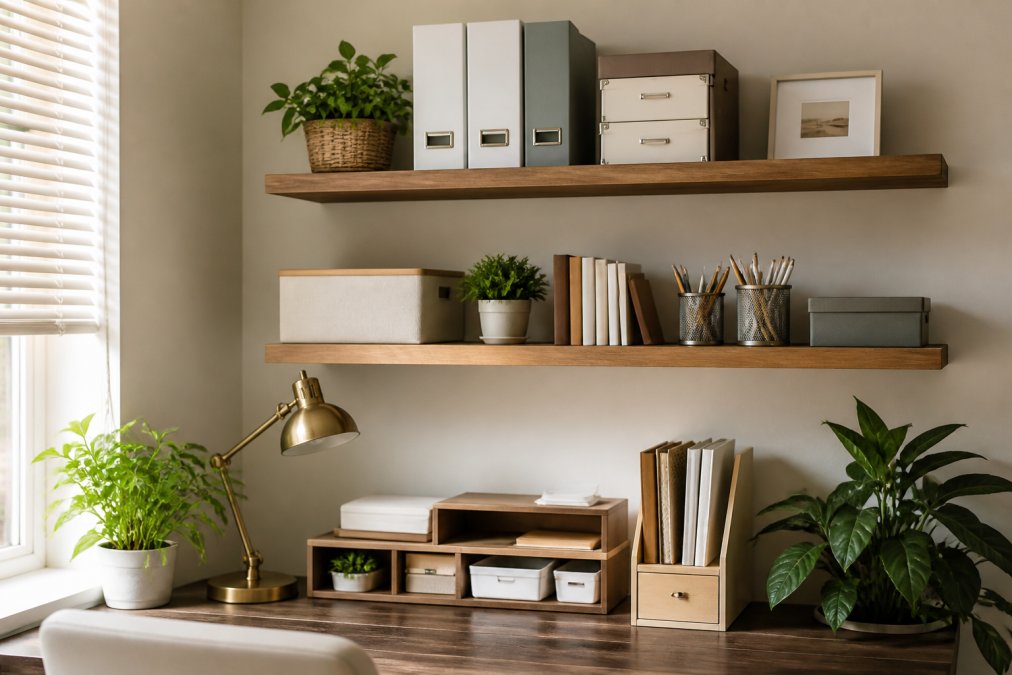
Wall-Mounted Shelves and Floating Storage
Floating shelves are the quickest win for vertical office storage. They hold weight without visual bulk and create clean lines that make small spaces feel larger. Install them 12-18 inches apart for easy access to items on each shelf.
Store reference books, frequently used supplies, and items you need to see daily. Avoid stacking too densely; visual breathing room matters in compact spaces. Keep the top shelf lighter and less cluttered; it sets the tone for the entire wall. Every item should serve a purpose, if you're storing something just because you have shelf space, reconsider whether you need it.
Pegboards and Magnetic Panels for Easy Access
Pegboards offer flexibility that shelves don't. You can rearrange hooks, baskets, and accessories in seconds as your workflow changes. A 2-foot by 3-foot pegboard can hold 15-20 items depending on what you hang.
Magnetic panels work similarly for metal items; desk organizers, scissors, rulers, and clips stick directly to the surface. They're especially useful above desks where you need quick access without reaching. Paint pegboards to match your office aesthetic and label each section so items return to their designated spots.
Small Home Office Storage Solutions: Drawers, Bins, and Dividers
Drawers are the hidden foundation of organized offices. What happens inside them determines whether your desk surface stays clear.
Drawer Dividers and Inserts for Office Supplies
Drawer dividers transform a single drawer into five or six organized sections, preventing pens, clips, and notepads from jumbling together. Adjustable dividers work best because you can customize sizes as your supply inventory changes.
Use vertical dividers, not horizontal stacking. Vertical storage lets you see everything at a glance without moving items. Stacked supplies bury what's underneath, creating situations where you buy duplicates because you forgot what you had.
Storage Bins and Trays for Clutter-Free Surfaces
Desk surface clutter comes from items without homes. Trays and bins create designated landing zones: an inbox tray for incoming documents, an outbox for completed work, and a project tray for current tasks. Choose transparent bins so you see contents without opening them. Label every bin clearly, even if the contents seem obvious.
Start with three bins per drawer: one for active supplies, one for backup stock, and one for miscellaneous items. Add more only when you consistently need them.
Decluttering a Tiny Workspace: What to Keep and What to Remove
Decluttering isn't a one-time event in a small office; it's a system. Every item competing for space must justify its existence.
The Inventory Audit Method
Remove everything from your desk, drawers, and shelves. Sort items into three categories: use weekly, use monthly, and haven't used in a year. Items in the third category go. For items you use monthly, consider whether they need to live on your desk or if they can move to storage elsewhere. Your desk should primarily hold items you touch at least twice per week.
Document what you keep by taking a photo of your desk after organizing and dating it. When clutter creeps back in, compare it to your baseline and identify what changed.
Creating a Minimalist Filing System
Scan documents and file digitally whenever possible. For paper that must stay, use a three-tier system: active files (current projects), reference files (documents you consult occasionally), and archive files (kept for legal or historical reasons).
Active files live in a small desktop file organizer. Reference files go in a drawer or cabinet. Archive files move to off-site storage or cloud backup. Label everything consistently using a label maker for professional appearance and to enforce naming conventions.
Cable Management and Desk Surface Optimization
Cables are the hidden productivity killer in small offices. They tangle, look chaotic, and make it harder to move things around when you need to clean or reorganize.
Cable Ties, Sleeves, and Under-Desk Organization
Trace each cable to its source and destination. Route cables that cross your work surface under the desk using cable clips or adhesive cable channels. Cable sleeves bundle multiple cables together, reducing visual clutter. Label each cable at both ends so you know what connects to what when you need to unplug something.
Under-desk cable management systems use clips or trays mounted to the underside of your desk, keeping cables completely out of sight while remaining accessible. A cable tray eliminates the most visible source of desk clutter.
Keeping Your Desk Surface Functional and Clear
Your desk surface should contain only what you actively use during your workday. A cluttered desk is a cognitive burden; your brain processes visual clutter as unfinished tasks, creating constant low-level stress.
Use the "one-touch" principle: when something lands on your desk, decide immediately whether to use it now, file it, or trash it. Don't create a pile of "things to deal with later." Use desk pads or mats to define your work zone and notice when clutter is creeping in.
Ergonomic Setup for Small Offices: Comfort Without Compromise
Compact doesn't mean uncomfortable. A poorly designed small office creates physical strain that undermines productivity gains from organization.
Your monitor should be at eye level when sitting upright. A monitor arm mounted to your desk uses minimal space while providing perfect positioning. Your chair height matters more than chair style; your feet should rest flat on the floor with knees at a 90-degree angle, and your elbows should be at the same height as your desk surface.
A compact desk doesn't require a huge footprint. A 48-inch desk provides enough surface for a monitor, keyboard, and a small working area. Pair it with vertical storage and you've created a fully functional office in 20 square feet.
Digital-Physical Hybrid Organization: Bridging Paper and Screens
Modern home offices exist in two worlds simultaneously. Disconnects between digital and physical systems create inefficiency. The solution is a unified naming and filing structure. If you have a "Client Projects" folder on your computer, you should have a "Client Projects" section in your physical filing system.
Create a simple index spreadsheet listing important documents, where they exist (physical only, digital only, or both), and their location. Update it whenever you file something new.
Labeling Systems That Work Across Both Worlds
Consistent labeling is the glue that holds hybrid systems together. Use the same label format everywhere: [Date] [Project Name] [Document Type]. A physical file labeled "2026-07-15 Acme Corp Contract" matches a digital file named "2026-07-15 Acme Corp Contract" instantly.
Use color labels on physical folders to indicate status: red for urgent, yellow for in-progress, green for completed. A label maker is one of the best small investments for office organization, upgrading the entire appearance of your filing system.
Neurodivergent-Friendly Organization Hacks
Traditional organization systems fail for many people with ADHD, autism, or other neurodivergent traits. Neurodivergent-friendly organization prioritizes visibility and friction reduction.
Make everything visible. Use transparent containers so you see supplies without opening them. Keep frequently used items in open baskets or on shelves rather than tucked away. Reduce friction for putting things away; if returning an item requires five steps, it won't happen. Design your system so returning items takes one step.
Create multiple "inboxes" for different types of items: one for papers to scan, one for supplies to put away, one for items to donate. This prevents decision fatigue.
Budget-Specific Tiered Solutions for Every Wallet
Organization doesn't require expensive furniture or systems. The most important factor is intention, not investment.
DIY and No-Cost Organization Strategies
Start with what you have. Repurpose containers, jars, and boxes as organizers. Mason jars hold pens and pencils. Shoeboxes become drawer dividers. Cardboard boxes become shelf organizers. Label everything clearly.
Create vertical storage with floating shelves you install yourself. Use your walls aggressively with Command hooks and adhesive strips to create storage without drilling holes. A wall of hooks can hold bags, headphones, and cables.
Mid-Range Multi-Functional Furniture Hacks
Furniture that serves multiple purposes justifies its cost in small spaces. A desk with built-in shelving above it provides work surface and storage in a single footprint. A filing cabinet with a flat top becomes both storage and an additional work surface.
Wall-mounted desks fold down when not in use, freeing floor space in micro-offices. A 36-inch fold-down desk provides full functionality when deployed and disappears when not needed.
A desk with a keyboard tray and monitor arm maximizes usable surface area. The keyboard tray pulls out when needed and tucks away when not, freeing desk space for other tasks.
| Organization Tier | Budget | Key Investments | Best For |
|---|---|---|---|
| No-Cost | $0-20 | Repurposed containers, adhesive hooks, label maker | Testing systems before investing |
| Budget-Friendly | $50-150 | Floating shelves, pegboard, small filing cabinet | Renters and those unsure of long-term setup |
| Mid-Range | $200-500 | Multi-functional furniture, wall-mounted desk, cable management system | Committed remote workers planning to stay |
| Premium | $500+ | Custom built-in shelving, high-end ergonomic furniture, professional organizing service | Those prioritizing aesthetics and maximum functionality |
Small spaces demand intentional organization, but they also offer an advantage: you can organize your entire office in a weekend. The systems covered here, vertical storage, drawer dividers, decluttering, cable management, and hybrid digital-physical filing, work together to create a functional workspace regardless of square footage.
Uniq Trenz offers curated organization tools and storage solutions designed specifically for compact spaces. From cable management systems to transparent storage bins and floating shelves, our collection prioritizes space-saving designs without sacrificing durability or aesthetics. Start shopping our home office organization collection and transform your small workspace into a productivity powerhouse.
The American Psychological Association on workplace stress and environmental factors
OSHA ergonomic guidelines for remote workers
National Association of Professional Organizers resources for space planning
Frequently Asked Questions
How do I organize a small home office with a lot of office supplies and equipment?
Start with a vertical storage strategy using wall-mounted shelves and pegboards to keep items off your desk surface. Use drawer dividers and labeled storage bins to categorize office supplies by type. Implement a filing system for documents and digitize what you can. Invest in multi-functional furniture like desks with built-in storage. The key is using every inch of wall and vertical space while keeping frequently used items within arm's reach and less-used items stored higher up or in closed bins.
What are the best small home office storage solutions for limited square footage?
Prioritize vertical storage solutions like floating shelves, wall-mounted organizers, and pegboards. Use drawer inserts and dividers to maximize desk drawer space. Incorporate storage bins and trays that fit under desks or in corners. Consider a lazy susan for rotating frequently accessed supplies. Multi-functional furniture, like ottomans with storage or desks with shelving, saves space. Label everything clearly so you can stack items vertically without losing track of what's stored where. Avoid bulky filing cabinets; use slim vertical file organizers instead.
How can I create an ergonomic setup in a compact home office without sacrificing organization?
Position your monitor at eye level and keyboard at elbow height, even in a small space. Use wall-mounted shelves above your desk for frequently used items rather than storing them on the desk itself. Keep cable management organized with cable ties and sleeves so wires don't create visual clutter or become a tripping hazard. Ensure your chair supports proper posture and fits the desk height. Use under-desk storage for items you need but don't use daily. Proper organization actually enhances ergonomics by reducing clutter-related stress and keeping your workspace functional and clear.
What's the difference between decluttering a tiny workspace and a regular office?
In a tiny workspace, every item must earn its place because square footage is severely limited. Use an inventory audit to identify items you actually use weekly versus those taking up valuable real estate. In a compact home office, implement a strict minimalist filing system, digitize documents when possible and keep only active files physically stored. Set boundaries on desk accessories and supplies. Consider neurodivergent-friendly organization hacks like color-coding or using clear bins so you can see contents without opening them. Regular decluttering is essential; what works in a larger office becomes overwhelming clutter in a small space.
This article was written using GrandRanker