

Table of Contents
- Quick Comparison: Best Under Sink Organizers for Small Kitchens
- Key Features to Consider Before You Buy
- How to Organize Under Sink Cabinets Step by Step
- Best Pull-Out Cabinet Organizers for Tight Spaces
- Space-Saving Kitchen Storage Ideas That Actually Work
- Weight Capacity, Durability, and Rental-Friendly Options
- Common Mistakes to Avoid Under the Sink
- Frequently Asked Questions
Last Updated: September 15, 2026
Quick Comparison: Best Under Sink Organizers for Small Kitchens
The best under sink organizers for small kitchens solve a specific problem: a cabinet squeezed by plumbing and cluttered with bottles. This guide from Uniq Trenz breaks down what actually fits, what holds weight, and what lasts, so you can stop guessing and start storing.
Small kitchens punish lazy storage choices. A standard base cabinet under the sink loses a large share of its usable volume to the P-trap and, in many homes, a garbage disposal. That leaves awkward gaps on either side of the plumbing where most organizers simply do not fit.
Below, we cover the three configurations that work in tight cabinets, the measurements you need before buying, and the mistakes that waste money. The options we recommend have a track record of fitting where rigid shelving fails.
| Option | Best For | Key Feature | Price |
|---|---|---|---|
| Shelf Kitchen Organizer | Adjustable, multi-use storage | Adjustable shelves | $26.99 |
| Wall-Mounted Multi-Grain Sealed Jars | Vertical, wall-based storage | Airtight wall mount | $33.99 |
| Silicone Sink Draining Mat | Faucet and counter protection | Flexible silicone | $12.99 |
Key Features to Consider Before You Buy
Size, material, and plumbing clearance decide whether an organizer works in your cabinet. Measure first, then match the product to the space you actually have.
Size, Material, and Plumbing Clearance
Plumbing clearance is the distance between your cabinet walls and the P-trap or disposal. A pull-out drawer needs a clear rectangular footprint, while open shelves and stackable bins can straddle the pipes.
Material matters for a wet environment. Look for rust-resistant finishes on metal frames and moisture-tolerant construction. Cheap coated wire corrodes fast under a leaking trap (Interim report no. 6. corrosion and creep testing of coated reinforcing bars in concrete...).
Measure three things before buying:
- Cabinet interior width, depth, and height
- Distance from the cabinet floor to the P-trap
- Door clearance for pull-out units
How to Organize Under Sink Cabinets Step by Step
Learning how to organize under sink cabinets starts with emptying the space and grouping items by how often you reach for them. Do that before you buy a single organizer. But the step most guides skip is the one that decides whether anything fits: mapping the plumbing itself.
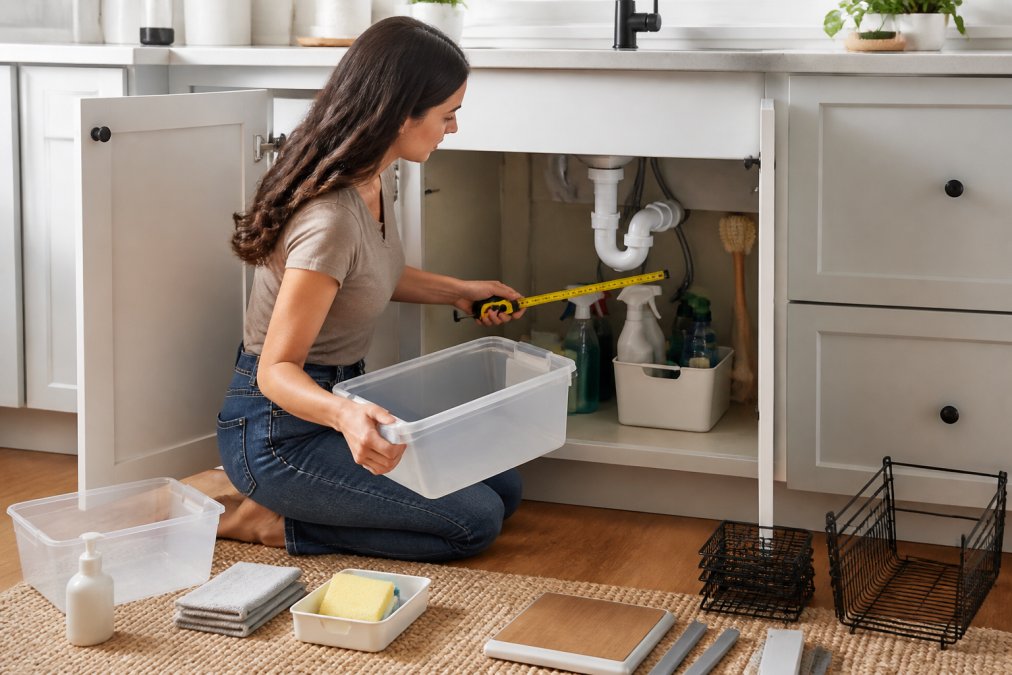
Step 1: Empty and Inspect the Cabinet
Pull everything out and wipe the base dry. While the cabinet is empty, look for three things: active drips at the P-trap slip nuts, corrosion on the disposal flange, and soft or swollen cabinet flooring. Organizing around a slow leak just hides the damage.
Step 2: Sort by Reach Frequency
Group items into daily (dish soap, sponges, scrub brushes), weekly (spray cleaners, gloves), and rarely used (bulk refills, holiday supplies). Daily items belong at the front edge of the cabinet, where you can grab them without kneeling.
Step 3: Map Your Plumbing Configuration
This is the step that separates a cabinet that works from one that fights you. Identify which of these three layouts you have, because each one blocks space differently:
- Standard P-trap, no disposal. The trap drops from the sink drain and curves back up, leaving usable floor space on both sides and behind the curve. Open shelves and stackable bins straddle the pipe easily.
- P-trap with a garbage disposal. The disposal hangs off the drain on one side, so the obstruction is wider and lower. Floor space is usually gone on the disposal side; the opposite side is your only clear zone.
- Deep or offset trap arm. Some sinks drain toward the back of the cabinet, pushing the trap against the rear wall. That frees the front half of the floor but blocks anything tall at the back.
Measure and write down four numbers before you shop:
- Interior width, depth, and height of the cabinet.
- Distance from the cabinet floor to the lowest point of the P-trap or disposal.
- Width of the clear zone to the left and right of the plumbing.
- Door opening clearance, measured at the hinge side, for any pull-out unit.
Step 4: Choose a Configuration That Clears the Obstruction
Match the organizer to the layout you mapped:
- Clear floor on one side: a single narrow pull-out or a stackable bin tower on that side only.
- No floor space at all: door-mounted or wall-mounted units that lift storage off the base.
- Low clearance under the trap: shallow bins that slide under the pipe rather than tall shelves that collide with it.
- Rear-blocked cabinet: front-loading bins with a low profile, so you reach over the trap instead of around it.
Step 5: Place Items by Weight and Access
Heavy liquids go on the floor or the lowest shelf, directly over a structural panel, never on a wire rack spanning open space. Rarely used items go behind the pipes; daily items go in front. Keep paper goods off the damp back wall.
Step 6: Protect the Base
Add a liner or draining mat under the bottles. It catches drips, stops bottles from sliding, and makes cleanup a wipe instead of a scrub. A dry base is what keeps metal frames from corroding.
Expected Result: A cabinet where your most-used spray and sponges sit within reach, bulky refills tuck behind the plumbing, and nothing collides with the trap when you open the door.
Best Pull-Out Cabinet Organizers for Tight Spaces
Pull-out cabinet organizers work best when you have a clear rectangular zone beside the plumbing. In narrow cabinets, a single sliding basket on one side beats a full-width unit that collides with the trap.
Our top pick is the Shelf Kitchen Organizer at $26.99. Its adjustable shelves let you build storage around the pipes instead of fighting them, and the same unit moves to a pantry or countertop if your kitchen layout changes.
For cabinets where floor space is gone, the Wall-Mounted Multi-Grain Sealed Jars at $33.99 shift storage onto the door or wall. The airtight lids keep dry goods fresh, and the wall design frees the cabinet floor entirely.
| Scenario | Recommended Option | Why |
|---|---|---|
| Clear floor space beside P-trap | Shelf Kitchen Organizer | Adjustable shelves fit the gap |
| No floor space left | Wall-Mounted Sealed Jars | Moves storage off the base |
| Wet, drippy cabinet base | Silicone Sink Draining Mat | Catches drips, protects surface |
Space-Saving Kitchen Storage Ideas That Actually Work
Good space-saving kitchen storage ideas share one trait: they use vertical storage and modular design instead of stacking on the floor. Height is the most wasted dimension under a sink.
Try these:
- Mount sealed jars on the cabinet door for dry goods and small tools
- Use stackable bins for sponges and cloths
- Add drawer glides to a low basket so it slides past the P-trap
- Keep a slim caddy for cleaning supplies storage
The Silicone Sink Draining Mat at $12.99 protects the countertop and sink area from water damage, which keeps the cabinet base dry and slows corrosion on metal frames. It comes in three sizes and wipes clean.
Weight Capacity, Durability, and Rental-Friendly Options
Weight capacity matters most when you store heavy liquids under the sink. A gallon of cleaning fluid weighs roughly eight pounds, and a row of them adds up fast (the EPA). A flimsy shelf sags under that load, and a collapse can crack the cabinet base.
How Much Weight to Plan For
Estimate your load before you buy. A common pattern is that a small under-sink cabinet holds three to five large liquid bottles, a caddy of sprays, and a bucket of cleaning tools. That can total 30 to 50 pounds sitting on one shelf or the floor (extension.psu.edu). Match the organizer's stated load rating to that number, and leave headroom rather than loading to the limit.
Material Trade-Offs That Decide Durability
- Powder-coated or chrome-plated steel: the strongest option for heavy liquids, but the coating is only as good as its coverage.
Distributing Weight So Nothing Sags
Rental-Friendly, Non-Permanent Solutions
Common Mistakes to Avoid Under the Sink
Frequently Asked Questions
What is the best organizer for under the kitchen sink?
The best under sink organizers for small kitchens depend on your plumbing layout and storage needs. Measure your cabinet depth and height first, then pick a modular design that fits around your garbage disposal.
How do I organize under sink cabinets when the space is tiny?
Start by emptying everything and grouping items by use: cleaning supplies, trash bags, sponges. Measure around the P-trap and garbage disposal to find usable zones. The Uniq Trenz Shelf Kitchen Organizer ($26.99) fits under the sink and adjusts to work around pipes, making it a practical pick for tight cabinets.
What is the best pullout organizer for under sinks?
Measure your cabinet opening width and depth before buying.
How do you maximize space in a small kitchen cabinet?
Use vertical storage to stack up, not out. Keep heavy liquids on the bottom. The Uniq Trenz Silicone Sink Draining Mat ($12.99) keeps the sink area dry so you can store more without moisture damage.