

Table of Contents
- Are Trending Home Products Actually Durable? The Short Answer
- Why Fast-Furniture Culture Prioritizes Aesthetics Over Longevity
- Materials That Stand the Test of Time: Durable Home Decor Essentials
- Sustainable Home Products Built for Real Longevity
- How to Identify High-Quality Craftsmanship and Structural Integrity
- Evaluating Product Quality: Testing Protocols and Repairability Index
- Timeless Home Design Principles That Outlast Trends
- Maintenance Tips for Long-Lasting Home Products in High-Traffic Areas
Are Trending Home Products Actually Durable? A 2026 Reality Check
Last Updated: August 1, 2026
The question of whether trending home products are actually durable has become impossible to ignore. Social media floods us daily with sleek furniture and innovative gadgets that promise to transform our living spaces, yet most vanish from trend cycles within months. The answer is nuanced: some trending items do stand the test of time, but most prioritize aesthetics over longevity.
Are Trending Home Products Actually Durable? The Short Answer
Trending home products are rarely durable by default. The majority prioritize aesthetics and affordability over craftsmanship and material integrity. However, some trending items from established brands or featuring specific material markers do stand the test of time.
The real issue is that fast-furniture culture has trained consumers to expect disposability at trend-friendly prices. When a sofa costs less than a weekend trip, few expect it to last a decade. This disconnect explains why homeowners end up frustrated, they purchase trending pieces based on design appeal, only to discover that structural integrity was sacrificed to hit a price point.
Why Fast-Furniture Culture Prioritizes Aesthetics Over Longevity
The modern home decor industry operates on a fundamentally different model than thirty years ago. Trends cycle faster, production scales higher, and consumer expectations have shifted from "buy once, keep forever" to "refresh seasonally." This is the explicit business model of fast-furniture retailers.
The Cost of Trendy vs. Timeless Design
Trendy design and durability exist in genuine tension when budgets are tight. A timeless wooden dining table with traditional joinery might cost three times what a trendy particle-board alternative costs. Yet the cost-per-use calculation flips when extended over time: a timeless piece used daily for twenty years costs a fraction per use compared to a trendy item replaced every four years.
What makes this worse is that trendy pieces often cost more than their longevity justifies. A fast-furniture sofa selling for $800 might last five years, while a traditional sofa at $2,400 might last thirty years. Yet the initial purchase barrier keeps consumers trapped in replacement cycles.
Planned Obsolescence in Home Goods
Planned obsolescence exists in home decor, though less discussed than in electronics. Some manufacturers design pieces that look dated quickly, encouraging replacement. Others use adhesives instead of joinery because adhesives fail predictably after a set timeframe.
The most insidious form is aesthetic obsolescence. A millennial pink accent chair was stunning in 2019; by 2026, it signals "outdated trend." The piece functions perfectly, but psychologically, it feels broken. Manufacturers understand this and design accordingly, creating a self-reinforcing cycle where disposability becomes normalized.
Materials That Stand the Test of Time: Durable Home Decor Essentials
Not all materials are created equal when it comes to longevity.
Solid Wood vs. Engineered Alternatives
Solid wood, particularly hardwoods like oak, maple, walnut, and cherry, represents the gold standard for furniture durability. These materials gain character over time through patina development. A solid wood table showing wear after fifteen years looks richer, not worse.
Engineered alternatives, plywood, MDF, particle board, and veneered surfaces, offer affordability and consistency but fail faster. Particle board absorbs moisture and swells. MDF dents easily. Veneer peels when humidity fluctuates. These materials are designed for a fifteen-year lifespan, not a lifetime.
Marketing often obscures this distinction. A product described as "solid wood construction" might have only visible surfaces in solid wood, with engineered materials comprising the back, interior, and structural supports. Reading specifications carefully is essential.
Hard-Anodized and Powder-Coated Finishes
For kitchen items and metal furniture, the finish determines durability more than the base material. Hard-anodized aluminum, created through an electrochemical process, produces a surface harder than steel. Cookware with hard-anodized finishes typically lasts fifteen to twenty years.
Powder-coated finishes on metal furniture create a durable, chip-resistant surface through an electrochemical process that bonds the coating stronger than paint. Outdoor metal furniture with quality powder-coating can last decades. Budget alternatives use thin paint coatings that chip within years.
Checking the thickness of the coating, typically measured in microns, reveals durability potential. Thicker coatings last longer.
Sustainable Home Products Built for Real Longevity
Sustainability and durability are increasingly linked. Products designed to last longer inherently have lower environmental impact because they require fewer replacements.
Environmental Impact and Product Lifecycle
The environmental cost of fast furniture extends beyond the individual product. Manufacturing, shipping, and disposal create cumulative impact. A piece thrown away after five years has generated waste and emissions that could have been spread across twenty years with a durable alternative.
Some manufacturers now design with product lifecycle in mind, using sustainable materials that are also durable, offering replacement cushions and hardware, and using non-toxic finishes. The most sustainable purchase is the one that lasts longest. A piece staying in use for thirty years has one-sixth the per-year environmental impact of a piece replaced every five years.
Functional design supports longevity. Pieces serving multiple purposes adapt as needs change. Modular furniture can be reconfigured rather than replaced. Neutral colors and timeless forms don't feel dated as trends shift.
How to Identify High-Quality Craftsmanship and Structural Integrity
Learning to spot quality requires understanding what separates durable pieces from disposable ones.
Signs of Poor Manufacturing Quality to Avoid
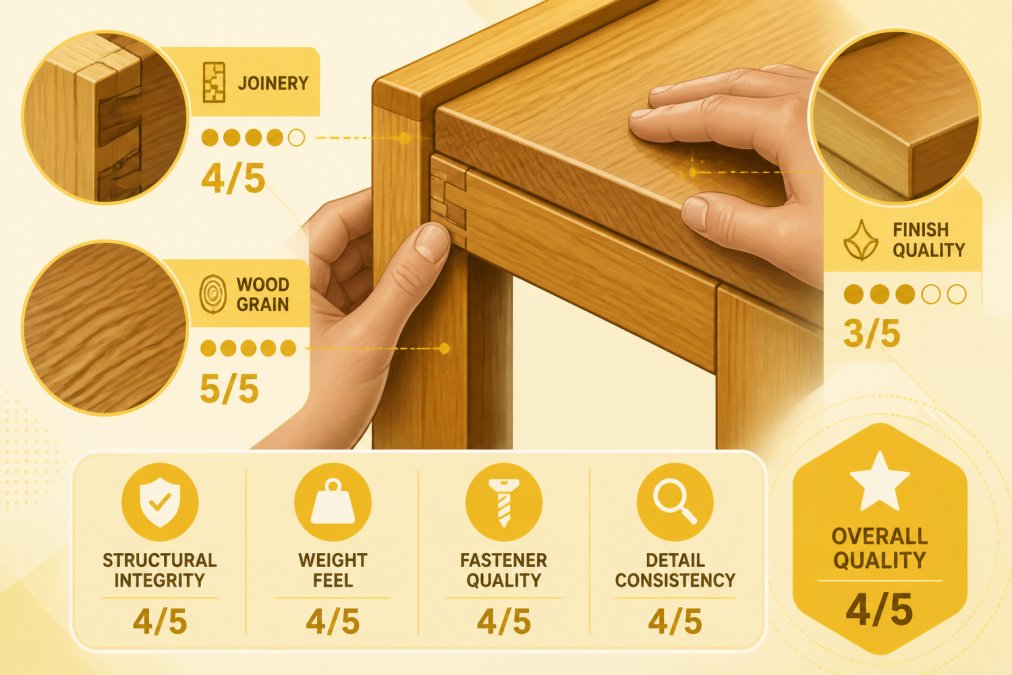
Poor manufacturing quality announces itself through specific markers. Uneven gaps between pieces indicate rushed assembly or warped materials. Loose joints that move under gentle pressure suggest inadequate adhesives or joinery. Finish inconsistency signals rushed application.
Check underneath furniture. Quality pieces have finished undersides and visible joinery. Budget pieces have raw particle board and staples instead of proper fasteners. Open drawers and examine joinery. Dovetail joints indicate quality; simple butt joints indicate budget construction.
Weight matters. Solid wood is heavier than engineered materials. If a piece feels suspiciously light, it's likely engineered materials. Smell is informative too. New furniture off-gassing strong chemical odors suggests cheap adhesives and finishes.
Joinery Techniques and Material Integrity Indicators
The way pieces connect determines structural integrity. Dovetail joinery, where interlocking wedge-shaped pieces lock together, represents the gold standard. Mortise and tenon joints are nearly as durable. Both require skilled craftsmanship and are expensive to produce.
Budget construction uses butt joints, dowels, or pocket holes. A chair assembled with dowels will develop wobble within years; the same chair with mortise and tenon joints will remain solid for decades.
Wood grain direction matters. Quality furniture uses grain direction strategically to minimize warping. Veneered surfaces should have grain running in consistent directions. Mismatched grain patterns indicate cost-cutting.
Finish quality extends durability significantly. Lacquer finishes (multiple thin coats) cost more than single-coat polyurethane but last longer. Oil finishes allow wood to breathe and patina naturally. Cheap finishes chip, peel, or become sticky over time.
| Quality Indicator | Budget Furniture | Quality Furniture |
|---|---|---|
| Joinery | Butt joints, dowels | Dovetail, mortise & tenon |
| Weight | Light (engineered materials) | Substantial (solid wood) |
| Finish | Single coat, uneven | Multiple coats, consistent |
| Undersides | Raw, stapled | Finished, visible joinery |
| Drawers | Particle board bottoms | Solid wood or plywood |
| Hardware | Plastic, lightweight | Metal, substantial |
Evaluating Product Quality: Testing Protocols and Repairability Index
Understanding how durability gets tested reveals what to look for when purchasing.
Durability Testing Standards and What They Mean
Furniture manufacturers use standardized tests to measure durability. The American Society for Testing and Materials (ASTM) publishes standards for furniture performance. ASTM F2050 measures seating durability through repeated flexing of chair frames. Products passing ASTM testing are more likely to perform well long-term.
Reputable manufacturers publish test results. If a company won't share durability data, that's a red flag. Quality brands often state expected lifespan: "Designed for 20 years of daily use" or "Tested to 50,000 cycles." These claims indicate confidence and provide realistic expectations.
Repairability as a Durability Measure
True durability includes the ability to repair. A sofa that costs $500 to reupholster after fifteen years is more durable than one that must be discarded because replacement parts don't exist. Products designed for repair last far longer than products designed for disposal.
Examine repairability before purchasing. Can cushions be replaced? Are legs removable? Can upholstery be changed? Are replacement parts available? These questions reveal whether the product is designed for longevity or replacement.
Modular design supports repairability. A sofa with removable cushions, legs, and arms can be updated or repaired without replacing the entire piece.
Timeless Home Design Principles That Outlast Trends
Design choices significantly impact whether a piece feels dated or timeless.
Functional Design Over Aesthetic Obsolescence
Functional design, where form follows function, naturally resists trend cycles. A well-designed chair is comfortable and looks good because it works well. Trendy chairs often sacrifice comfort for appearance.
Timeless pieces solve problems. A wooden storage bench stores items, seats people, and works in nearly any aesthetic. A trendy accent table serving no function becomes clutter when the trend passes.
Neutral palettes feel current across decades. Bold trend colors feel dated quickly. Proportion and scale matter too. Well-proportioned pieces that relate to human scale feel timeless; oversized furniture feels trendy.
Investment Pieces That Build Resale Value
Some purchases are investments. A quality sofa, bed, or dining table retains value because replacements cost more than buying used. Resale value indicates durability; items that hold value are durable because people pay for them.
Timeless design supports resale. A mid-century modern wooden table appreciates over time; a trendy particle-board table becomes difficult to give away. Building a home with investment pieces costs more initially but creates cumulative value.
Maintenance Tips for Long-Lasting Home Products in High-Traffic Areas
Durability requires maintenance. Regular dusting prevents dirt accumulation that scratches surfaces. Wooden furniture benefits from periodic conditioning with appropriate oils or waxes. Upholstered furniture lasts longer when vacuumed regularly and spot-cleaned promptly.
Environmental control matters significantly. Maintaining consistent humidity (around 45-55%) extends wooden furniture lifespan considerably. Rotation extends lifespan, rotating cushions prevents uneven wear. Rearranging furniture distributes wear patterns.
Use appropriate cleaning products. Water-based cleaners work for most surfaces. For wood, furniture-specific products preserve the finish. For upholstery, test cleaners on hidden areas first.
Strategic placement extends valuable furniture lifespan. Placing quality pieces in low-traffic zones and budget pieces in high-traffic areas protects investments. Understanding wear patterns helps too, armrests and seat edges wear fastest on sofas. Protective elements like throws and corner guards extend durability.
The reality is that trending home products can be durable, but durability requires intentional choices. Most trendy items prioritize aesthetics over longevity, but some from quality manufacturers do last. The key is learning to distinguish between products designed for longevity and those designed for replacement. When evaluating any trending home product, examine the joinery, check the materials, verify repairability, and calculate cost-per-use across a realistic lifespan. This approach transforms purchasing from trend-following into informed decision-making that builds a home you'll love for decades.
Frequently Asked Questions
What makes a trending home product actually durable?
True durability in trending home products depends on material integrity, joinery quality, and finish durability. Look for solid wood or high-grade composites, reinforced joints, and protective coatings like hard-anodized finishes. Products designed with functional design principles rather than pure aesthetics tend to last longer. Check for quality control standards and whether the manufacturer offers repair services, this signals confidence in longevity.
How can I spot signs of poor manufacturing quality before buying?
Watch for loose joints, uneven finishes, flimsy hardware, and thin materials that feel hollow. Mass-produced trending items often use particle board or veneers that deteriorate quickly. Examine seams, check weight (quality items are typically heavier), and look for consistent color and texture. Read reviews specifically mentioning wear and tear after 6-12 months. Reputable brands publish durability testing results; if none are available, that's a red flag.
Are sustainable home products more durable than fast-furniture alternatives?
Generally, yes. Sustainable home products prioritize material integrity and longevity as core values, reducing environmental impact over the product lifecycle. They typically use raw materials designed to age gracefully, like solid wood that develops patina, rather than materials engineered for aesthetic obsolescence. However, sustainability alone doesn't guarantee durability; always verify construction quality, joinery techniques, and finish quality regardless of eco-friendly claims.
What's the real cost difference between investing in durable home products versus trending items?
While durable pieces often cost more upfront, the cost-per-use over time is significantly lower. A trendy item lasting 1-2 years costs far more annually than an investment piece lasting 10+ years. Durable products also retain resale value, offsetting initial expense. Consider total environmental impact too, replacing items frequently generates waste. Calculate long-term value rather than focusing on the price tag alone when evaluating trending home products.
This article was written using GrandRanker