

Table of Contents
- What Makes Chunky Gold Hoop Earrings a Timeless Choice
- Chunky Gold Hoops Comfort and Weight: What You Need to Know
- Solid Gold vs. Gold-Plated: Understanding the Real Difference
- Gold-Plated Hoop Earrings Durability and Long-Term Value
- Chunky vs. Thin Gold Hoop Earrings: Which Style Pays Off
- How to Choose Hoop Earring Size for Your Face and Style
- The Real Cost-Per-Wear Case for Investing in Quality Hoops
- Frequently Asked Questions
Last Updated: October 4, 2026
What Makes Chunky Gold Hoop Earrings a Timeless Choice
Chunky gold hoop earrings have remained a staple in fashion for decades, and for good reason. These bold accessories deliver instant polish to any outfit, whether paired with casual jeans or formal wear. The appeal lies in their versatility, they work across age groups, face shapes, and personal styles without feeling dated or trendy in a way that demands replacement.
At Uniq Trenz, we've observed that customers investing in quality chunky gold hoops often report wearing them far more frequently than other jewelry pieces. The reason is straightforward: a well-made pair becomes a reliable foundation piece that coordinates with nearly everything in a wardrobe.
The real question isn't whether chunky gold hoops are worth owning. It's whether the investment in solid gold, gold-filled, or gold-plated options makes sense for your lifestyle and budget. Understanding the differences between these materials, their durability, and how they perform over time is what separates a smart purchase from an expensive mistake.
Chunky Gold Hoops Comfort and Weight: What You Need to Know
Comfort matters more than most people realize when selecting chunky gold hoop earrings. A pair that looks stunning but causes ear fatigue or soreness won't get worn, regardless of how beautiful it is.
Weight and Wear Duration
Weight is the primary comfort factor. Solid gold is denser than many assume, and larger diameters compound this significantly. A solid 14k gold hoop measuring 2 inches in diameter typically weighs between 8-12 grams per pair, depending on the wire gauge. For comparison, a 1-inch solid gold hoop usually weighs 2-4 grams.
Many wearers find that hoops larger than 2 inches create noticeable tension on the earlobe after 6-8 hours, particularly for those with sensitive ears, thin earlobes, or stretched piercings. The sensation isn't pain but rather a persistent pulling sensation that can lead to soreness by day's end.
Gold-filled and gold-plated options solve the weight problem by using a thin layer of gold over a lighter base metal (typically brass or copper). A gold-filled hoop of the same diameter typically weighs 40-50% less than solid gold, while gold-plated versions can be even lighter.
Backing Style and Closure Impact
The backing style affects both comfort and weight distribution. Lever-back closures (also called French wires) distribute weight across the back of the ear and tend to feel more secure during movement, though they add slightly more weight than post-and-clutch systems.
Testing different closure types before committing to a purchase reveals which feels best for your ear anatomy. If you experience discomfort with one style, switching the backing type often solves the problem without requiring a new pair of hoops.
Ear Anatomy and Individual Tolerance
Earlobe thickness and piercing placement vary significantly. Thicker earlobes naturally tolerate heavier earrings better than thin ones. If your piercings are placed higher on the lobe (closer to the head), weight distribution feels different than piercings placed lower.
For those with sensitive ears or nickel allergies, material composition matters as much as weight. Even lightweight gold-plated hoops can cause irritation if the base metal contains nickel. Gold-filled and solid gold options eliminate this concern entirely, making them the better choice for sensitive skin regardless of weight considerations.
Solid Gold vs. Gold-Plated: Understanding the Real Difference
Solid gold is exactly what it sounds like: the entire piece is gold. Purity is measured in karats, 14k gold contains 58.3% pure gold mixed with other metals for durability, while 10k gold contains 41.7% pure gold. Higher karat weights (18k, 22k) are softer and more prone to bending or warping with regular wear.
Gold-filled consists of a thick layer of gold (at least 5% of the total weight) bonded to a base metal core, typically brass. This construction provides significantly more durability than gold-plating while keeping weight and cost lower than solid gold.
Gold-plated is a thin electroplated layer of gold over base metal. The coating can range from a few microns to slightly thicker applications, but it's fundamentally fragile compared to the other two options.
The practical difference: solid gold lasts indefinitely with basic care, gold-filled typically lasts 5-10 years with regular wear before the gold layer begins showing wear at stress points, and gold-plated may show wear within 1-2 years depending on how often the earrings are worn and how they're stored.
For chunky gold hoop earrings specifically, solid 14k gold offers the best balance of durability and wearability. It resists denting and scratching far better than softer karats, and it won't flake or fade like plating can.
Gold-Plated Hoop Earrings Durability and Long-Term Value
Gold-plated hoop earrings can be excellent short-term investments if expectations align with reality. They allow experimentation with chunky styles and sizes without significant financial commitment. However, they're not designed for permanent ownership.
The lifespan depends heavily on wear frequency and care. Earrings worn daily will show gold layer degradation faster than those worn occasionally. Exposure to moisture, sweat, perfume, and lotions accelerates tarnishing and flaking. Proper storage, in a dry place, ideally in individual pouches, extends life somewhat, but the underlying limitation remains.
Many people find that replacing gold-plated hoops every 1-2 years becomes frustrating and wasteful. The cost adds up quickly, and the environmental impact of frequent replacement is worth considering. This is where the cost-per-wear calculation shifts in favor of investing in better materials upfront.
Gold-filled pieces occupy a middle ground. They resist tarnishing much better than plating and can be refinished or replated if needed, making them repairable in ways that pure plating isn't. For someone seeking a balance between durability and affordability, gold-filled chunky gold hoop earrings often deliver better long-term value than plated options.
Chunky vs. Thin Gold Hoop Earrings: Which Style Pays Off
The choice between chunky and thin hoops isn't purely aesthetic, it's also practical. Thin hoops are lighter, more delicate, and generally more affordable. They suit minimalist aesthetics and work well for everyday wear without making a statement.
Chunky hoops make an immediate visual impact. They draw attention, command presence, and feel more substantial. For many wearers, this boldness is exactly why they're worth the investment. A pair of quality chunky gold hoops can anchor an entire outfit and be worn across multiple seasons and styles.
The durability consideration also differs between the two. Thin hoops are more prone to bending or kinking because they have less structural integrity. A chunky hoop with thicker gauge wire resists deformation much better, even with regular handling and storage.
From a cost perspective, chunky hoops in solid gold cost more upfront, but the durability advantage means they maintain their appearance longer. A thin gold-plated hoop might need replacing annually, while a chunky solid gold hoop can look pristine for years. When calculated over a decade, the investment in chunky quality often costs less per year of wear.
How to Choose Hoop Earring Size for Your Face and Style
Hoop diameter dramatically affects how an earring complements your face shape, ear size, and overall proportions. Choosing the right size requires balancing aesthetic impact with practical wearability.
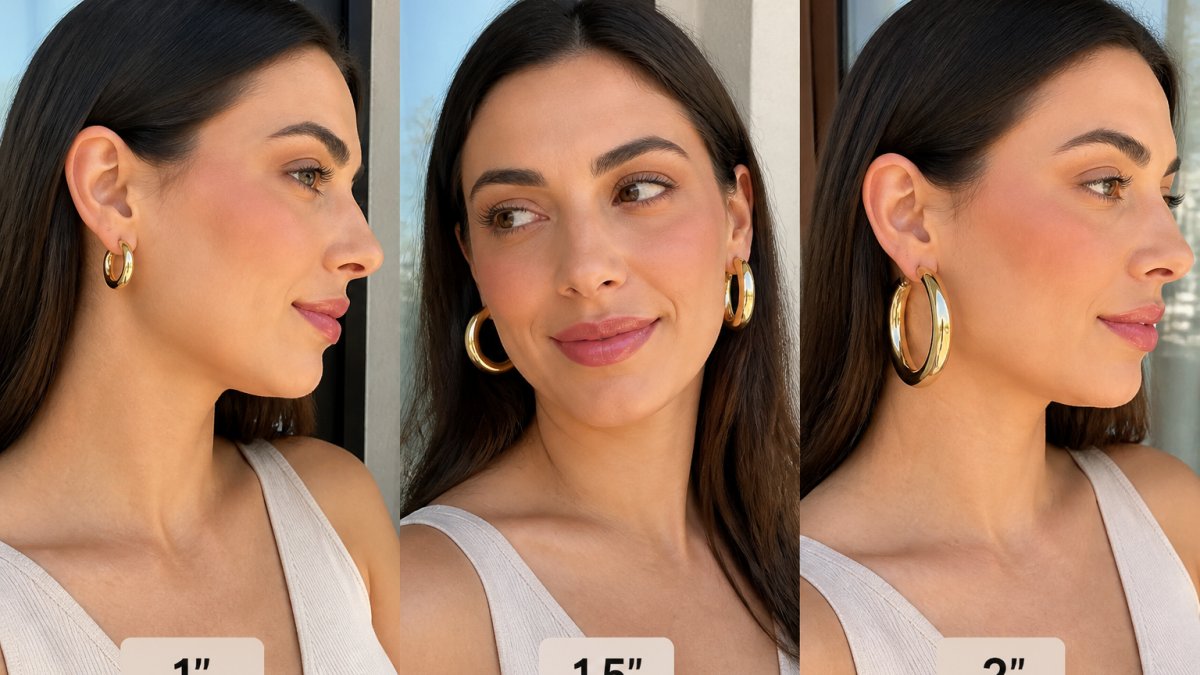
Face Shape and Diameter Guidelines
For round faces, larger chunky gold hoop earrings (2 to 2.5 inches) elongate the face and create visual contrast that flatters rounded contours.
Square faces benefit from rounded or curved hoops that soften angular features. Diameter should fall in the 1.5 to 2.25-inch range; anything smaller risks looking proportionally lost, while anything larger can overemphasize width.
Oval faces are the most versatile and can wear nearly any size successfully, from 1.25 inches to 2.75 inches. The key is personal preference rather than proportion constraints.
Long or rectangular faces should avoid hoops larger than 2 inches, as additional length can overextend facial proportions. The 1.25 to 1.75-inch range typically works best.
Ear Size and Lobe Proportion
Ear anatomy matters as much as face shape. Measure your earlobe from the top of the piercing to the bottom of the lobe; this measurement determines the maximum comfortable hoop diameter.
For individuals with smaller or delicate ears, hoops larger than 2 inches often look disproportionate regardless of face shape.
Wire Gauge and Visual Impact
Thickness matters as much as diameter. A 2-inch hoop with thin gauge wire (approximately 1.2 mm) looks delicate and understated, while the same diameter in thick gauge (approximately 3 mm or thicker) appears bold and statement-making.
Thicker gauge also provides the durability advantage mentioned earlier, less likelihood of bending or warping over time, making it a practical choice beyond aesthetics.
Lifestyle and Context
Beyond proportion, consider personal style and lifestyle. A professional environment might call for 1.5-inch hoops in moderate thickness, while casual settings allow for 2.5-inch or larger statement pieces.
Testing Before Purchase
Testing different sizes before purchasing is ideal. Many jewelry retailers allow returns or exchanges, making it possible to try options and determine what feels right on your ear and looks proportionate to your frame.
When trying on hoops, wear them for at least 2-3 hours to assess comfort, and view yourself in natural daylight and indoor lighting to see how the size and finish read in different settings.
The Real Cost-Per-Wear Case for Investing in Quality Hoops
Cost-per-wear is a useful framework for evaluating whether chunky gold hoop earrings are worth the investment. The calculation is simple: divide the total cost by the number of times worn.
A pair of solid 14k gold chunky hoops might cost significantly more upfront than gold-plated alternatives. However, if worn 2-3 times per week for 5-10 years, the cost per wear becomes remarkably reasonable, often less than a dollar per wearing. Gold-plated hoops worn the same frequency might need replacement after 1-2 years, adding replacement costs that eventually exceed the price of one quality pair.
This logic extends beyond pure economics. There's also the satisfaction factor: wearing jewelry that maintains its appearance and doesn't require constant replacement feels better than managing frequent upgrades.
For busy professionals and parents, the audience Uniq Trenz serves, reliable pieces that require minimal maintenance and perform consistently over years make practical sense. Quality chunky gold hoop earrings fit this profile perfectly. They're grab-and-go accessories that never let you down, never look tired or worn, and work with nearly everything in your closet.
The investment also eliminates decision fatigue. Instead of debating whether to replace worn-out plating or managing multiple pairs at different stages of deterioration, a single quality pair becomes a permanent wardrobe anchor.
Chunky gold hoop earrings represent one of the few jewelry investments that genuinely pays dividends over time. The real value isn't in the trend or the aesthetic appeal, though both matter. It's in the reliability, durability, and versatility of a well-chosen pair that performs consistently year after year. Understanding the material differences, comfort factors, and sizing considerations transforms the purchase from a fashion whim into a thoughtful investment in a piece that earns its place in your daily rotation.
Frequently Asked Questions
Are chunky gold hoop earrings comfortable to wear all day?
Comfort depends on material and weight. Solid gold hoops are denser but timeless; gold-filled options offer a lighter alternative. Look for smooth inner surfaces and secure closures to avoid irritation. Many wearers find chunky gold hoops comfortable for everyday wear when the diameter and thickness match their ear structure. Start with shorter wear periods if you're new to heavier earrings.
How do you know if chunky gold hoops will last through everyday wear?
Durability hinges on material choice and construction. Solid gold resists tarnishing and maintains its finish indefinitely with basic care. Gold-plated hoops require more attention; the plating can wear with friction over time. Inspect the clasp mechanism, secure, well-made closures prevent loss and damage. Quality craftsmanship in the hoop's structure also matters; thicker, well-constructed hoops resist bending and breaking better than thin, poorly finished pieces.
What size chunky hoop earrings should I choose?
Size depends on face shape, earlobe size, and personal style. Smaller diameters (30-40mm) suit petite features or professional settings. Medium sizes (40-50mm) work for most face shapes and remain versatile. Larger diameters (50mm+) make a bold statement but can overwhelm smaller faces. Hold samples near your ear or use a mirror to visualize proportions. Consider daily activities, very large hoops can catch on clothing or hair during active days.
Are gold-plated chunky hoops worth buying if solid gold costs more?
Gold-plated hoops offer lower upfront cost and work well for trend-testing or occasional wear. However, solid gold or gold-filled options provide better durability and longer lifespan, making them better long-term value if you plan to wear chunky hoops regularly. Calculate cost-per-wear: a quality solid gold pair worn for years often costs less per wear than replacing plated hoops every 1-2 years. Your wearing frequency and budget should guide the choice.